|
|
Kamoa Capital Sunday Wrap
|
|
April 12, 2026
|
|
|
Top News and Deals this week:
|
•
|
Central Banks Remain Net Gold Buyers In February Despite Rising Geopolitical Uncertainty
Central banks bought a net 27 tonnes of gold in February, a rebound from January's lull and in line with the 2025 monthly average of 26 tonnes, according to World Gold Council data. Poland led with 20 tonnes, bringing its reserves to 570 tonnes, while Uzbekistan added 8 tonnes. UBS projects full-year 2026 central bank purchases at 800 to 850 tonnes, describing the possibility of a structural shift toward large-scale gold sales as extremely low.
|
|
•
|
Gold Output At Top North American Miners Wanes As Global Rivals Gain
Newmont, Agnico Eagle and Barrick all produced less gold in 2025 than the prior year and each expects output to fall further in 2026, as high-quality acquisition targets grow scarcer and existing operations are optimised rather than expanded. By contrast, China's Zijin Mining, Africa-focused AngloGold Ashanti and Uzbekistan's Navoi Mining recorded production increases over the same period. The divergence is reshaping the global rankings for annual gold production, with established North American producers ceding ground to rivals with greater appetite for developing smaller projects and absorbing divested assets.
|
|
•
|
BHP Scores Victory, Fights Off Union Pilbara Push
The Electrical Trades Union notified BHP that overtime bans and work restrictions involving up to 50 high-voltage power workers would begin the following Thursday, marking the first protected industrial action in the Pilbara in decades. The workers, essential to powering BHP's mine sites and camps, are seeking their first collective workplace agreement after more than a year of failed negotiations. BHP said it did not expect major operational impacts from the action, though the ETU warned the bans could escalate into stoppages without progress toward a pay deal.
|
|
•
|
Gold Price Climbs To Three-Week High On US-Iran Ceasefire
Gold climbed to its highest in three weeks on April 8 after the US and Iran agreed to a two-week ceasefire brokered by Pakistan, easing inflation concerns that had been weighing on the metal. Spot gold rose as much as 3% to over $4,850 per ounce, though prices remain down around 9% since the war began in late February, recovering from their worst monthly performance since the 2008 global financial crisis. Goldman Sachs has a $5,400 per ounce price target, while Wells Fargo carries an upside target of $6,300.
|
|
•
|
G Mining To Buy G2 Goldfields For $3B In Guyana Play
G Mining Ventures announced a C$3 billion all-share deal to acquire G2 Goldfields, consolidating two adjacent projects in Guyana's Guiana Shield into a single district-scale operation targeting more than 500,000 ounces of gold annually over the life of mine. G2 shareholders will receive 0.212 G Mining shares per share held, representing a 72% premium to recent trading averages. The deal is expected to generate over C$1 billion in synergies through shared infrastructure and permitting, with closing targeted for the second quarter of 2026.
|
|
•
|
Argentina Passes Mining Reform To Spur Investment Near Glaciers
Argentina's Chamber of Deputies passed President Javier Milei's glacier protection reform 137 votes to 111 on April 9, narrowing federal protections to glaciers with proven hydrological functions and giving provinces authority to determine which areas can be opened to mining and hydrocarbon activity. Mining sector estimates suggest the new framework could unlock over $30 billion in investment over the next decade, with Economy Minister Luis Caputo projecting mining and energy exports could reach $75 billion by 2035. Environmental groups have pledged legal challenges, arguing the changes threaten freshwater reserves for millions of Argentines.
|
|
•
|
Barrick Signals Deal Push Amid Strategic Reset
Barrick Mining is pivoting back to acquisitions while retreating from higher-risk jurisdictions, reversing the Africa and Asia expansion strategy pursued over the past decade under former CEO Mark Bristow. Chairman John Thornton outlined the shift in a shareholder letter, his first public comments since Bristow was replaced in September and plans to spin off North American assets were announced. The strategic reset comes after production fell 17% in 2025 to 3.26 million ounces, the company's lowest output in at least 25 years, weighed down by the Loulo-Gounkoto closure in Mali and delays at Reko Diq in Pakistan.
|
|
•
|
AI Turns BHP's Oversized Rocks Into Supersized Returns
BHP has deployed computer vision systems at its Western Australia iron ore operations to detect oversized rocks and foreign objects on conveyor belts before they damage equipment or cause unplanned stoppages, eliminating disruption events that historically accounted for over 1,000 hours of downtime in pilot programs. The same approach is applied at Escondida in Chile, where AI-supported digital twins help operators manage ore variability and have reduced some production losses by up to 70% in targeted applications. BHP's digital and analytics initiatives have delivered more than US$2 billion in value over the past four financial years.
|
|
•
|
Resources Funds Betting On 'Explosive Rally' After Horror Month
Resources funds that were among the best-performing equity strategies in 2025 are now nursing heavy double-digit losses from the Iran war, with Acorn Capital's NextGen Resources Fund tumbling more than 20% in March as ASX-listed gold stocks were hit by fears of simultaneous inflation and an economic slowdown. Gold prices fell 12% in March, their worst monthly performance since the 2008 global financial crisis. Fund managers have responded by pouncing on the rare pullback in miners, positioning for what they expect to be an explosive rebound.
|
|
•
|
This War Shows Why Australia Needs to Go Nuclear Now
The Iran conflict and its devastating impact on Australia's fuel security have reignited the debate over nuclear power, with the article arguing the crisis has exposed the structural vulnerability of relying almost entirely on imported refined fuel. Trump signalled the war was winding down on March 31, declaring the hard part was done and that Iran had been "essentially, decimated," but the damage to Australia's energy resilience has already been laid bare. The author argues the episode demonstrates why Australia cannot afford to remain the only IEA member without 90-day fuel reserves or a domestic nuclear energy option.
|
|
•
|
Australia Amends Policies to Ensure Commodity Security
The Australian government is amending the Export Finance and Insurance Corporation Act to give Export Finance Australia new authority to underwrite additional cargoes of critical imports including fuel and fertiliser, as rising risk premiums prevent independent importers from securing spot volumes on commercial terms. The powers will allow EFA to issue insurance, indemnity contracts, guarantees and loans to help firms hedge risk so they can secure cargoes and get them to Australia quickly, Energy Minister Chris Bowen said. The measures are targeted at independent importers supplying regional areas, several of which have been left without fuel after suppliers prioritised contracted customers during the crisis.
|
|
•
|
Critical Global Oil Price Reaches Highest Price On Record
Dated Brent, the global benchmark for physical crude oil, reached $144.42 per barrel, its highest price on record, according to Bloomberg citing S&P Global Energy Platts, surpassing the previous record set during the 2008 financial crisis. The record was driven by the ongoing US-Israel conflict with Iran and the effective closure of the Strait of Hormuz, through which roughly 20% of global oil flows. The price has since pulled back sharply following the announcement of a two-week US-Iran ceasefire on April 8.
|
|
•
|
Australian Miners Warn of Industry Crisis as Diesel Costs More Than Double
Gold miner Capricorn Metals flagged diesel supply as a material risk for the Australian mining industry, while Ramelius Resources said it is currently paying more than double its forecast for diesel despite supply to its WA operations remaining uninterrupted. Ramelius has contingency plans in place in case rationing or further supply restrictions are imposed, and is considered among the less exposed operators given its mill is largely powered by solar and gas. The warnings come as the Middle East conflict continues to drive fuel price rises across Australia's resources sector, particularly for operators in remote regions.
|
|
•
|
Ghana Awards Gold Fields' Damang Mine Lease to Local Firm Engineers & Planners
Ghana awarded the Damang gold mine lease to wholly Ghanaian-owned Engineers & Planners following a competitive tender, ending Gold Fields' 30-year tenure at the asset with a formal handover scheduled for April 18. E&P demonstrated access to $505 million in financing, meeting the government's minimum funding threshold, and scored 93.15% in the technical and financial evaluation, outperforming three rival bidders. The award marks a significant shift toward local ownership of large-scale mining operations, with the government assuring workers that no layoffs will occur during the transition.
|
|
•
|
Namibia Draws Investor Interest in Critical Minerals as Exploration Activity Expands
Mining junior Kaoko Metals announced plans to raise up to A$6.5 million as part of its ASX listing to advance exploration across its Chalkos and Karibib assets in Namibia, joining a growing wave of investor interest in the country's critical mineral potential. Momentum is building across lithium at the Uis project, rare earths through Namibia Critical Metals' Lofdal project and Aldoro Resources' Kameelburg deposit, and copper via Koryx Copper's Haib project. The activity is diversifying Namibia's mining sector beyond its traditional base of diamonds, uranium and gold.
|
|
•
|
Africa to Pilot Bond Aimed at Formalising Artisanal Mining
Canada-based advisory firm Veridicor and Zambia's Metalex Commodities are piloting a "stakeholder prosperity bond" designed to integrate artisanal miners into formal supply chains by linking investor returns to social and environmental outcomes rather than output. The debut issuance is targeting between $100 million and $200 million by year-end to help Metalex integrate small-scale miners through regulated offtake agreements and shared infrastructure, with Zambia, Africa's second-largest copper producer, hosting the pilot. Potential investors include European sustainability funds, impact investors and banks focused on social outcomes.
|
|
•
|
DFC Backs Revival of Key Antimony Project to Bolster Industrial Supply Chains for U.S. and Allies
The US International Development Finance Corporation signed a project development agreement with Australian company Pela Global for up to US$5 million to advance the Krstov Dol brownfield antimony mine restart in North Macedonia, marking DFC's first antimony investment and first project in the country. Antimony is a critical input for defence, semiconductor and energy applications, with limited near-term allied production capacity making the project strategically significant. Pela Global is also in discussions with US-based PGM Processing for a commercial offtake arrangement to supply antimony concentrate to American markets.
|
|
•
|
Barrick Welcomes Ontario Court of Appeal's Dismissal of Appeal Concerning North Mara Gold Mine
The Ontario Court of Appeal dismissed an appeal by Tanzanian residents alleging human rights abuses by members of the Tanzanian Police Force in the vicinity of Barrick's North Mara gold mine in Tanzania. The ruling upheld an earlier Superior Court of Ontario decision that Ontario is not the appropriate forum and that the claims must be adjudicated in Tanzania. Barrick said evidence filed during the case established that the Tanzanian Police Force acts independently of the company, which maintains a zero tolerance policy for human rights violations.
|
|
|
|
What I found interesting this week...
China Controls 60–99% of the Minerals That Matter.
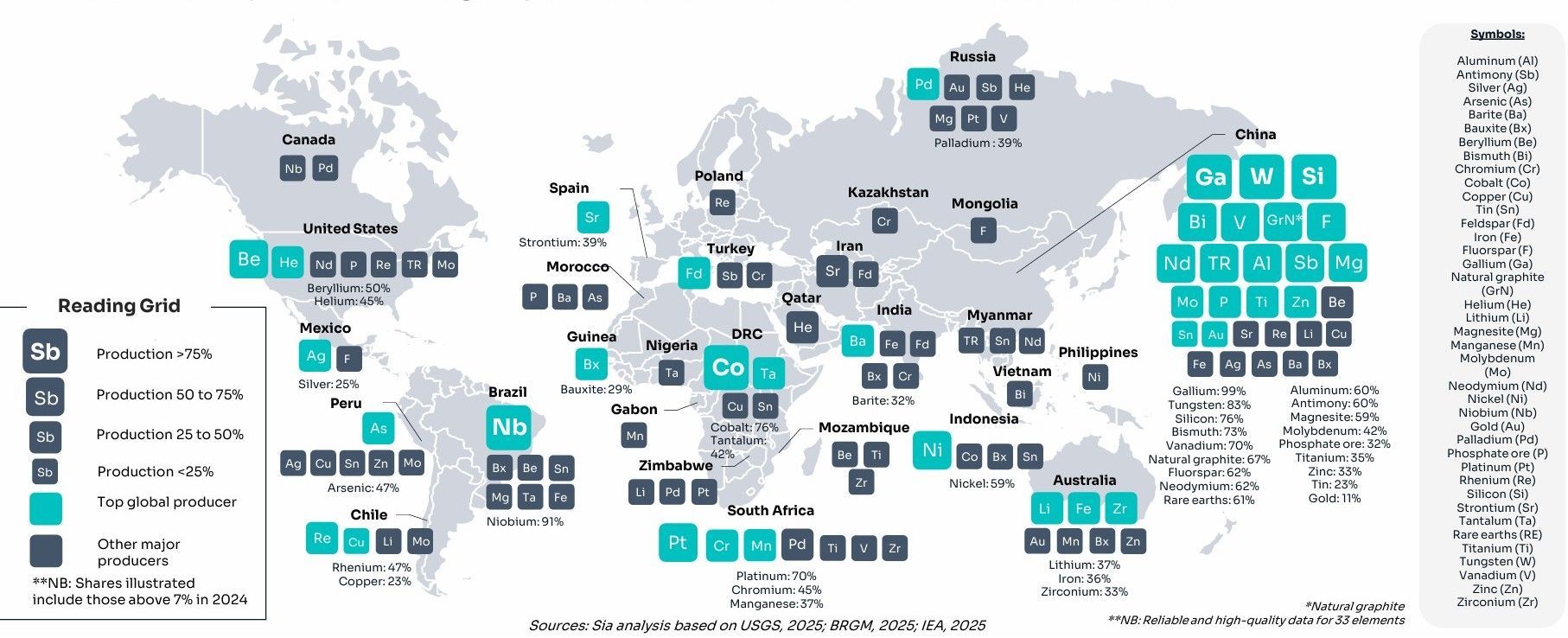
A single map tells you everything the policy papers won't say plainly. China controls more than 60% of global production across gallium, tungsten, rare earths, natural graphite, antimony, aluminium, and silicon. Neodymium and fluorospar sit at 62%. Bismuth at 73%. Gallium at 99%.
Read the full article HERE
|
|
|
A State-Owned Uzbek Miner Just Outproduced Barrick on Cost by $279 Per Ounce.
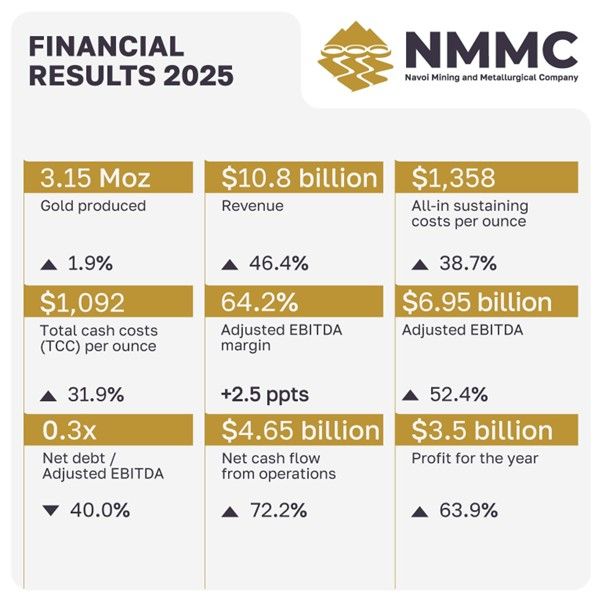
Navoi Mining and Metallurgical Company - Uzbekistan's national gold producer - reported its 2025 financial results. Revenue hit $10.8 billion. Adjusted EBITDA came in at $6.95 billion. Net profit reached $3.5 billion, up 63.9% year-on-year. Operating cash flow surged 72.2% to $4.65 billion.
Read the full article HERE
|
|
|
Zijin just spent US$6.6 billion on gold in 60 days.
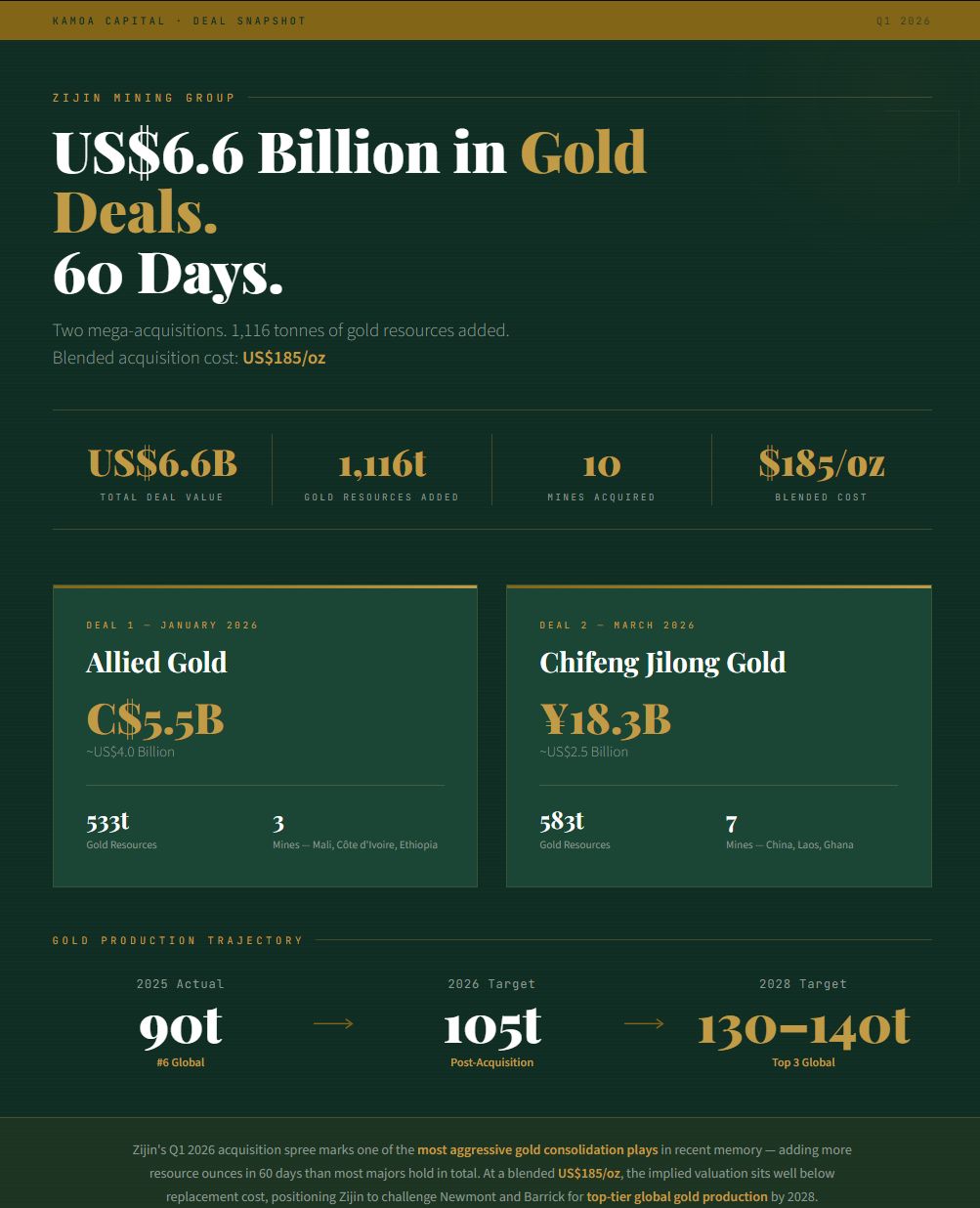
Newmont Corporation and Barrick Mining Corporation couldn't have done the same deal if they'd wanted to.
Two mega-acquisitions, Allied Gold Corporation in January, Chifeng Jilong Gold Mining Co., Ltd. in March, added 1,116 tonnes of gold resources at a blended cost of roughly US$185/oz.
Read the full article HERE
|
|
|
Barrick Signals Deal Push Amid Strategic Reset
Barrick Mining (TSX: ABX) (NYSE: B) is pivoting back to acquisitions while retreating from higher-risk regions, reversing a decade-long strategy that emphasized expansion across Africa and Asia.
Chairman John Thornton outlined the shift in a letter to shareholders Wednesday, marking his first public comments since the company replaced Mark Bristow as chief executive officer in September and unveiled plans to spin off key North American assets.
Read the full article HERE
|
|
|
Gold Price Climbs to Three-Week High on US-Iran Ceasefire
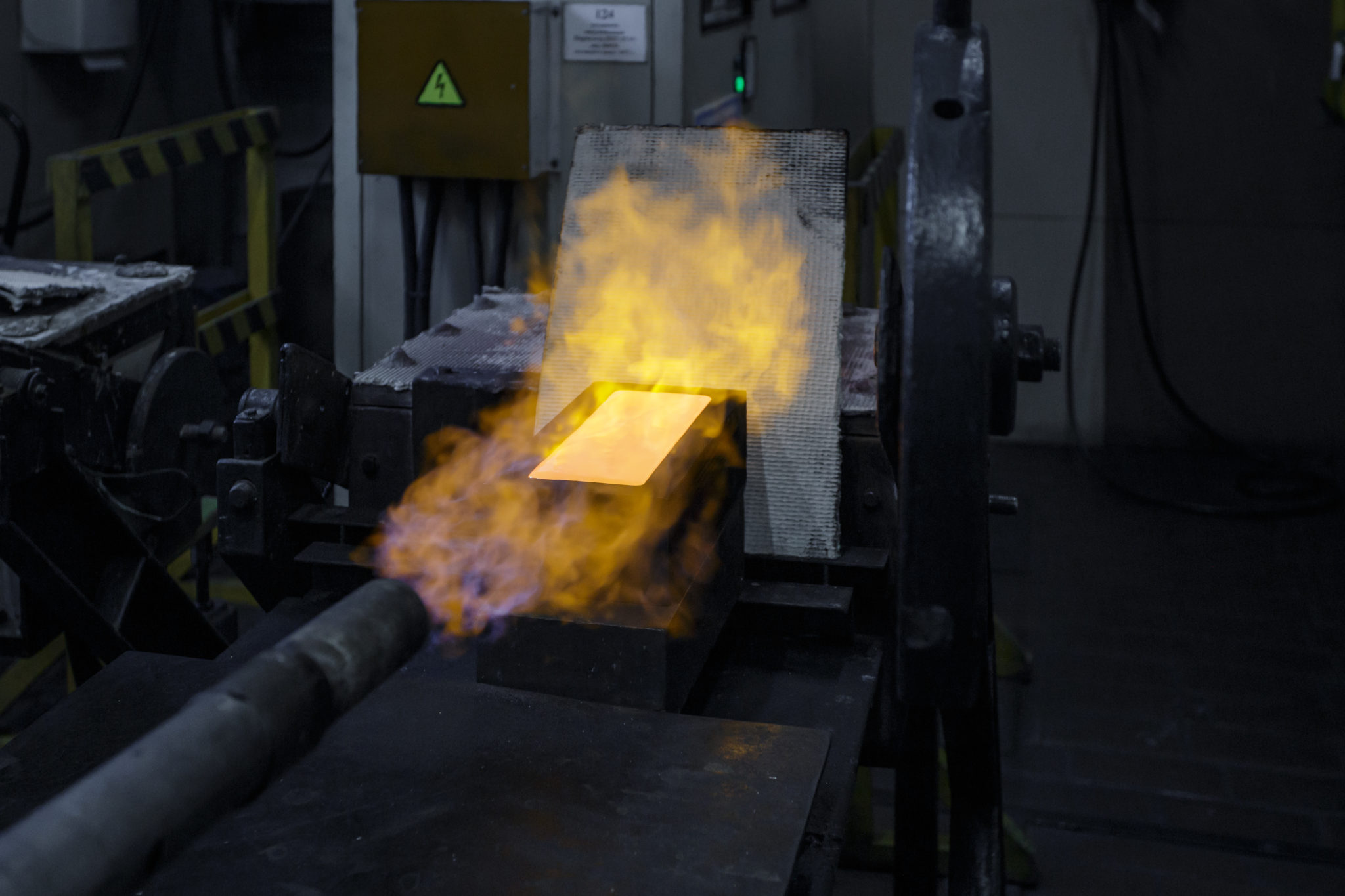
Gold climbed to its highest in three weeks on Wednesday after the US and Iran agreed to a two-week ceasefire, calming inflation worries that have upended global markets.
Spot gold rose as much as 3% to over $4,850 per ounce, extending its previous session's gains in the lead-up to the ceasefire announcement.
Read the full article HERE
|
|
|
|
|
Our newsletter is available to all. Please share this link to enable others to subscribe:
Share
|
|
This newsletter is for general information, education & entertainment. Kamoa Capital is not licensed and does not know your circumstances. Nothing here is financial, legal or tax advice - seek professional advice and read any PDS before acting. We aim | |


